
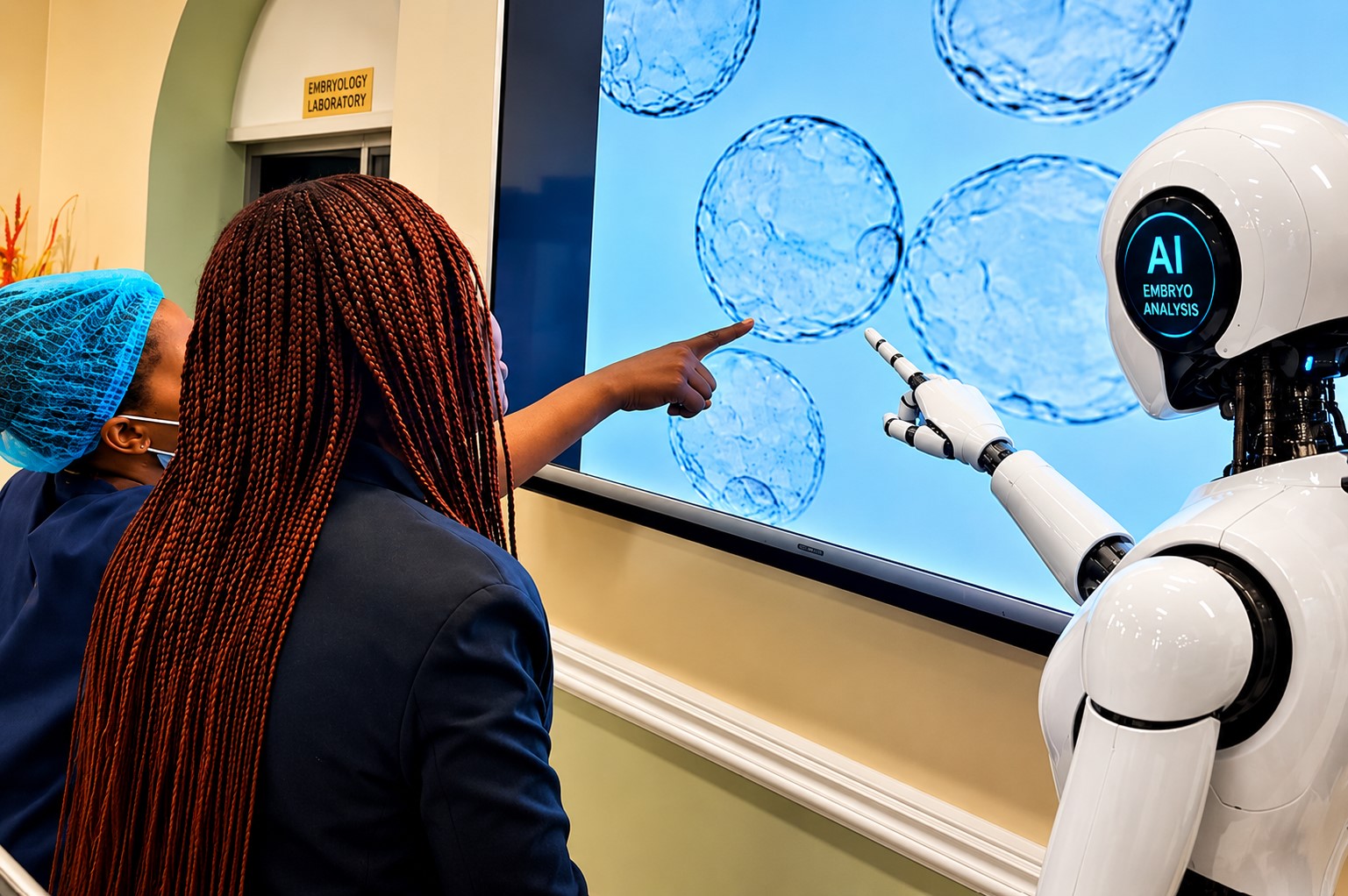
Developing embryos
Deep inside an IVF laboratory, an embryologist sits quietly in front of a screen studying a group of developing embryos. To most people, the images look almost identical, tiny clusters of cells suspended in carefully controlled conditions.
But to the trained eye of an embryologist, each embryo may tell a different story.
Some divide evenly. Others fragment. Some develop beautifully for days before suddenly slowing down. Tiny differences in timing, symmetry, and development may influence whether an embryo implants successfully, develops into a pregnancy, or stops growing entirely.
For decades, selecting the “best embryo” depended largely on human expertise and microscopic observation. Experienced embryologists spent years training their eyes to recognize subtle developmental patterns that might predict success.
Now, however, a new question is emerging inside fertility clinics around the world:
Could artificial intelligence choose embryos better than humans?
It sounds futuristic, almost uncomfortable at first. The idea that computer systems could participate in one of the most emotionally significant moments of human life naturally raises curiosity and caution.
But artificial intelligence is already quietly entering modern reproductive medicine.
Using thousands (sometimes millions) of embryo images and treatment outcomes, AI systems are being trained to identify patterns that may not be easily visible to the human eye. Some systems analyze:
-
-
- embryo shape,
- cell division timing,
- developmental speed,
- fragmentation patterns,
- and even subtle image characteristics invisible during routine observation.
-
The goal is not to “replace doctors,” as many people initially fear.
Rather, researchers hope AI can assist embryologists by improving consistency, reducing subjectivity, and helping identify embryos with higher chances of implantation.
One of the challenges in IVF has always been that embryo grading can vary slightly between professionals. Two highly experienced embryologists may sometimes rank embryos differently because human interpretation naturally contains some subjectivity.
Artificial intelligence attempts to standardize that process.
In some early studies, AI-assisted embryo assessment has shown promising ability to predict implantation potential and pregnancy outcomes. Researchers believe this could eventually help clinics:
-
-
- improve embryo selection,
- reduce multiple pregnancies,
- shorten time to pregnancy,
- and possibly reduce emotional and financial strain for patients.
-
But despite the excitement, the conversation is far from simple.
Many fertility experts emphasize that embryos are not mathematical objects alone. Successful pregnancy depends not only on embryo quality, but also on:
-
-
- uterine receptivity,
- hormones,
- genetics,
- immune interactions,
- age,
- and overall patient health.
-
An embryo that appears “perfect” under AI analysis may still fail to implant, while another embryo graded lower may lead to a healthy baby.
This is why many specialists see AI not as a replacement for human expertise, but as a powerful support tool.
There are also ethical questions.
Some people worry:
-
-
- Could clinics rely too heavily on algorithms?
- How transparent are AI decisions?
- What happens if patients begin trusting machines more than clinicians?
- Could technology unintentionally introduce bias based on the data used to train it?
-
These are serious discussions currently happening across fertility medicine globally.
Yet one thing is becoming increasingly clear:
the IVF laboratory of the future will likely look very different from the IVF laboratory of the past.
Time-lapse incubators already allow embryos to be monitored continuously without repeated handling. Digital imaging systems can track developmental milestones hour by hour. AI platforms are beginning to integrate embryo images, patient characteristics, laboratory conditions, and clinical outcomes into predictive models.
What once sounded like science fiction is slowly becoming clinical reality.
For patients, however, perhaps the most important reassurance is this:
fertility care remains deeply human.
Behind every embryo is a couple carrying hope, anxiety, financial sacrifice, and emotional vulnerability. No algorithm can replace empathy, counselling, ethical judgment, or compassionate clinical care.
Artificial intelligence may eventually help embryologists make more informed decisions.
But the dream of parenthood will always remain profoundly personal.
And perhaps the future of fertility medicine is not humans versus machines.
Perhaps it is humans and technology working together (carefully, ethically, and thoughtfully) to improve the chances of creating life.
Add Your Comment